The Pitfalls of Relying on Data Loss Prevention Alone
Data Loss Prevention (DLP) solutions are often the heroes of our data security stories.

Data Loss Prevention (DLP) solutions are often the heroes of our data security stories.
Hybrid computing environments, including multi-cloud and on-prem applications, have challenged enterprises to create uniform data security policies. This heterogeneity has forced enterprises to restrict cloud apps from being shared with third parties, which adds friction to external collaboration in many ways.

In today’s technology landscape, traditional perimeter security measures such as firewalls and DLP systems are no longer sufficient to protect sensitive data. A more effective approach is data-centric security, which includes four fundamental principles: data classification and labeling, access control at the data level, data encryption, and continuous data monitoring and auditing. By adopting this proactive approach, organizations can meet compliance regulations, prevent insider threats, and secure data in cloud and mobile environments while safeguarding sensitive data from a wide range of cyber threats. Read more to learn more about this approach.
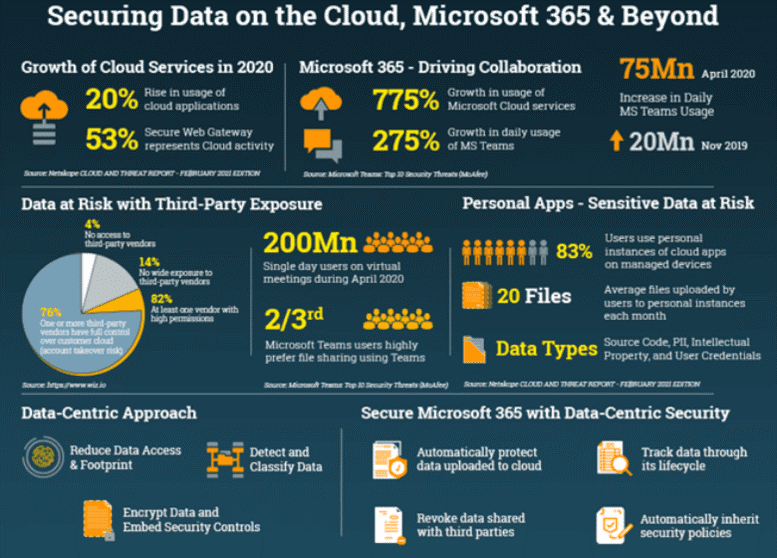
Organizations have left no stone unturned to adopt collaboration services, which saw an increase of up to 600% in usage due to the “New Normal.”

External collaboration is an essential aspect of any business.

With privacy regulations in full effect and more organizations using the cloud due to Covid-19, the seismic shift for data-centric security in the cloud has never been greater.

McAfee and Seclore have come together to address the problem of protecting information at the endpoint, email, or cloud.

This October, we released Seclore 3.15 that significantly enhances Seclore Classification-Driven Data Protection, an integral component of the Seclore Data-Centric Security Platform.

Seclore Data-Centric Security Platform enables organizations to leverage existing investments in security and compliance.

In this vlog, Vishal Gupta, CEO at Seclore discusses the power of combining DLP with Rights Management.
Data Loss Prevention (DLP) solutions are often the heroes of our data security stories.
Hybrid computing environments, including multi-cloud and on-prem applications, have challenged enterprises to create uniform data security policies. This heterogeneity has forced enterprises to restrict cloud apps from being shared with third parties, which adds friction to external collaboration in many ways.
In today’s technology landscape, traditional perimeter security measures such as firewalls and DLP systems are no longer sufficient to protect sensitive data. A more effective approach is data-centric security, which includes four fundamental principles: data classification and labeling, access control at the data level, data encryption, and continuous data monitoring and auditing. By adopting this proactive approach, organizations can meet compliance regulations, prevent insider threats, and secure data in cloud and mobile environments while safeguarding sensitive data from a wide range of cyber threats. Read more to learn more about this approach.
Organizations have left no stone unturned to adopt collaboration services, which saw an increase of up to 600% in usage due to the “New Normal.”
External collaboration is an essential aspect of any business.
With privacy regulations in full effect and more organizations using the cloud due to Covid-19, the seismic shift for data-centric security in the cloud has never been greater.
McAfee and Seclore have come together to address the problem of protecting information at the endpoint, email, or cloud.
This October, we released Seclore 3.15 that significantly enhances Seclore Classification-Driven Data Protection, an integral component of the Seclore Data-Centric Security Platform.
Seclore Data-Centric Security Platform enables organizations to leverage existing investments in security and compliance.
In this vlog, Vishal Gupta, CEO at Seclore discusses the power of combining DLP with Rights Management.