
Seclore for Banking & Financial Services
Data Protection for Banks and the Financial Services Industry
The banking and financial services industry is a favored target of threat actors. Financial institutions are a treasure trove of personal data that can be used for identity theft to open up false credit cards or sold on the black market for gain. The personal information that financial institutions hold, especially in the United States, is highly sought-after for that reason.
Successful breaches, such as the one involving insurance company Genworth Financial in July 2023, result in the exposure of sensitive data for millions of people. This causes lawsuits, lost revenue, and even fines from major regulators depending on local rules.
Banks and financial institutions need to protect their customers’ sensitive data and also comply with data privacy and security regulations such as the General Data Protection Regulation (GDPR) in Europe, the Gramm Leach Bliley Act (GLBA) in the United States, and PCI DSS – the general data security standard for payment card industry data.
Ultimately, however, financial organizations need a way to comply with regulations while also providing a seamless experience for their customers. This has to involve data security that defends sensitive data and provides granular controls to ensure that personal information is accessible and safe.

Seclore Secures Areas of Risk in the Financial Services
Area of Risk | Prevention |
|---|---|
Client confidentiality breaches | Know and track who within the bank and third parties have access to sensitive PII data, as well as the ability to recall or revoke access on demand. |
Financial exposure and reputational damage | Gain insights into and protect the integrity of the trade and counterparties associated with bilaterally uncleared OTC derivatives to prevent financial exposure and reputational damage. |
Insider trading | Set controls and make material non-public information (MNPI) available and accessible to only authorized users on the buy & sell sides to prevent insider threats. |
Leakage or theft of sensitive data by third-party vendors | Validate third-party vendor access and entitlement levels and mitigate unauthorized and unwanted access attempts. |
Sensitive digital assets are shared with limited visibility, security, and control, exposing financial services firms to the risks of regulatory fines, reputational damage, lawsuits, market reaction, and high incident cost.
Get an overview of how Seclore provides data protection in the financial services industry.
Banking & Financial Regulations and Compliance
Seclore helps banks and financial institutions achieve and maintain compliance
PCI-DSS
Learn more about how Seclore can help you comply with PCI-DSS.
RBI Guidelines
Learn more about how Seclore can help you comply with the RBI guidelines.
23 NYCRR 500
Learn more about how Seclore can help you comply with the 23 NYCRR 500.
Cyber Risk in Financial Services
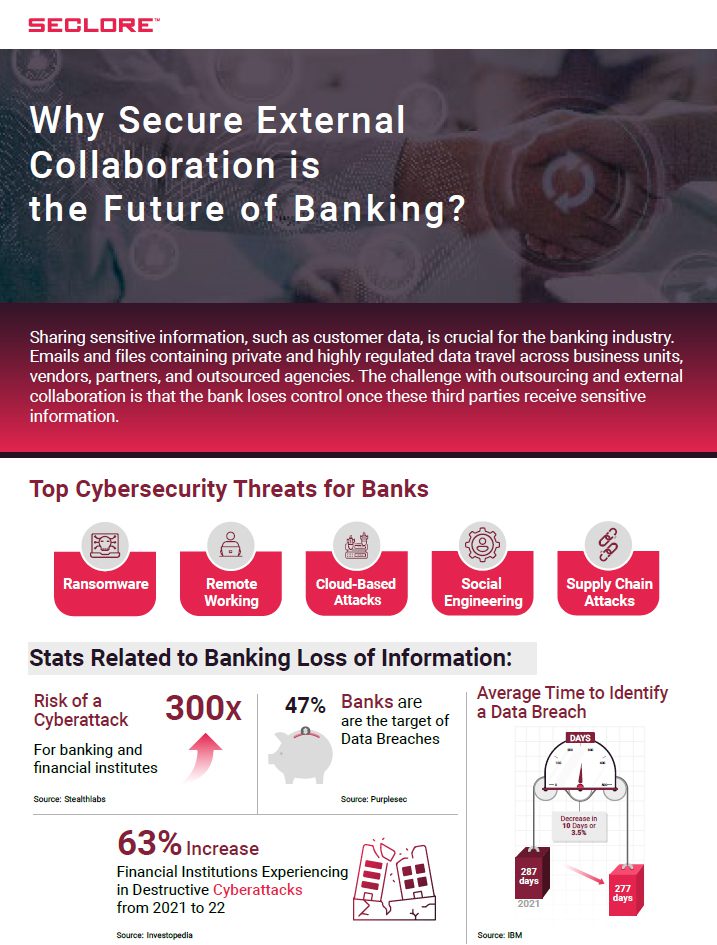
Seclore Secures Financial Services Organizations

Millions
500,000+
60,000
Trusted by Financial Service Enterprises






A Guide to Financial Data Protection, Security, Compliance, and Regulations
Data-centric security is a key strategy and tactic for protecting sensitive data in the financial services sector. By prioritizing the security of data, financial services firms can better protect their customers’ information and comply with data protection regulations.

Seclore Digital Asset Protection for Banking

FAQ About Data-Centric Protection for Banks and the Financial Services Industry
Financial institutions have to comply with a patchwork of data privacy and security regulations depending on which country they do business in. Banks who wish to lend in the United States, for example, must comply with the Gramm Leach Bliley Act (GLBA), Sarbanes-Oxley, and FINRA. Doing business in the European Union requires compliance with the General Data Protection Regulation (GDPR).
There are also three major global regulations that every financial institution worldwide must comply with. These are the PCI DSS for payment card industry data, the ISO/IEC 27001 regulation that governs information security management systems, and SWIFT CSP for wire transfers and payments between banks worldwide.
Banks and financial institutions have a few different consequences for a data breach. There are the immediate recovery costs and lost time in terms of staff productivity, as well as the knock-on effect of lost revenue over the long term. Government regulators worldwide have the financial industry under intense scrutiny, which means that a mistake in data protection for banks and the financial services industry could result in fines.
Noncompliance with the Gramm Leach Bliley Act in the United States, for example, could result in a civil penalty of up to $10,000 per violation and imprisonment for up to five years. Every financial data breach brings increased regulatory oversight, so ensuring that sensitive data is protected properly is paramount to reduce the risk of a hefty fine should a breach occur.
Setting up a security perimeter around critical systems is best practice for internal data protection. The problem is that sensitive customer data needs to be accessible from anywhere at any time. Perimeter-based security isn’t enough in this environment.
This is the power of data-centric security like Seclore. Adding protection at the level of data ensures that protection is where it’s needed most in the financial services industry: right with PII and other personal financial information.
Seclore Protects PII

30,000+
450+
5,000+
Additional Resources
Seclore Named Best-In-Class Data Security Solution
See why Max Life Insurance named Seclore a best-in-class data and infrastructure security solution in their annual report.
Complying with IRDAI
Learn how Seclore helps insurance providers comply with the The Insurance Regulatory and Development Authority of India (IRDAI).